Nationwide Emergency Water Extraction & Rapid Structural Drying
When a catastrophic pipeline failure submerges your property, seconds dictate your structural survival. Our unified dispatch network instantly deploys elite disaster recovery crews to contain flooding, extract standing water, and stabilize your asset.
🚨 NATIONAL WATER DAMAGE DISPATCH HOTLINE
Heavy-Duty Equipment Crews Stationed Regionally • Available 24/7/365
📞 CALL NOW: (800) 555-0199Authorized for New Homeowner & Commercial Structural Damage Claims Only
⚡ IICRC Standards Compliant • Direct Insurance Billing Coordination • Rapid On-Site Response Units
Enterprise-Grade Property Mitigation When Time is the Ultimate Adversary
A sudden, high-pressure pipeline rupture or a primary sewer line backflow is not a standard maintenance issue—it is an immediate threat to the structural integrity of your property. Within minutes of a massive water intrusion, porous building materials like insulation, drywall, and structural hardwood lumber begin absorbing moisture at an exponential rate. Without immediate, heavy-duty mitigation, this deep liquid saturation induces rapid material degradation, sub-surface foundation warping, and hazardous mold spore colonization.
At Emergency Pipe Cleanup, we operate a sophisticated, nationwide emergency routing grid engineered to close the critical window between initial property failure and professional source containment. Our platform functions as a single, unified point of dispatch, instantaneously matching distressed residential and commercial property owners with highly specialized, asset-stabilization crews. We do not patch simple fixtures; we execute comprehensive, high-ticket property de-watering, advanced environmental drying, and biological decontamination protocols designed to return your asset to pre-loss compliance standards.
Our Premium Structural Recovery Pillars
We connect property owners with advanced remediation personnel equipped with industrial fleets. Here is how our network addresses serious property crises:
| Disaster Service Type | Primary Equipment Deployed | Core Risk Controlled |
|---|---|---|
| Industrial Water Extraction | Truck-mounted high-volume vacuum loops & submersible pumps. | Deep hydrostatic pooling, ceiling collapses, and deep basement submersion. |
| Structural Air Dehumidification | LGR (Low Grain Refrigerant) units & high-velocity axial air movers. | Sub-surface vapor trapping, drywall rot, and load-bearing wood warping. |
| Hazardous Sewage Sanitization | EPA-approved antimicrobial chemical washes & HEPA air scrubbers. | Blackwater biological hazards, chemical airborne pathogens, and persistent odors. |
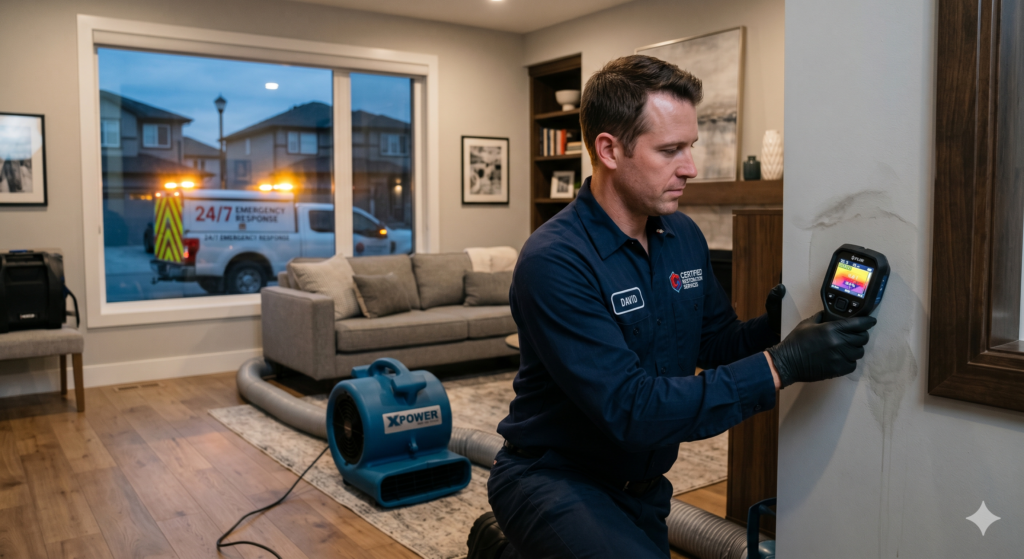
| Thermal Moisture Mapping | Infrared thermal imaging arrays & digital penetrative meters. | Hidden moisture pockets behind structural drywall and deep subfloors. |
Controlling the Physics of Structural Evaporation
Many property owners mistakenly assume that removing visible surface water solves the crisis. In reality, standing water is merely the visible symptom of a complex environmental emergency. Liquid water naturally tracks along lines of least resistance, wicking horizontally and vertically into internal wall framing, structural insulation jackets, and bottom plate plates. Once locked within these tight building cavities, natural evaporation drops to near zero, creating a stagnant, high-humidity microclimate.
Scientific Reality: If relative humidity within an impacted indoor envelope remains above 60% for more than 48 hours, dormant fungal spores trigger germination, inducing irreversible structural contamination that standard homeowners policies may restrict if mitigation was delayed.
The specialized restoration crews routed through our platform use physical evaporation principles to save your building. By combining high-velocity axial air movers with industrial-grade LGR dehumidifiers, they create an aggressive, low-vapor-pressure internal environment. This forced desiccation pulls hidden water molecules right out of dense building structures, capturing the vapor and draining it away safely before permanent foundational decay settles in.
Our 4-Step Professional Tactical Response
From the moment our emergency processing dispatch desk registers your inbound call, our coordinated network follows a synchronized protocol to secure your property:
1. Instant Asset Profiling
Our centralized line instantly collects your geographical zip code and records your structural loss metrics, establishing priority dispatch clearance.
2. Specialized Fleet Deployment
The nearest regional dispatch truck loaded with extraction pumps and industrial structural drying configurations is routed straight to your structure.
3. Structural De-Watering
Crews execute high-volume surface extraction while deploying penetrative and non-penetrative thermal detection tools to locate sub-surface tracking lines.
4. Documented Stabilization
Technicians establish precise dehumidification drying loops, outputting digital psychrometric moisture logs to build clear, undeniable evidence profiles.
Direct Insurance Adjuster Coordination & Compliance Tracking
Managing a major property flood is stressful enough without having to navigate complicated insurance terminology. High-ticket water damage claims require meticulous field data logging to secure full policy coverage approvals. Insurance adjusters require clear, empirical proof that the on-site team implemented immediate, standard-compliant dry-out protocols to mitigate secondary property damage.
The certified field supervisors within our emergency response network understand this dynamic implicitly. They don’t just clear away water; they build an ironclad documentation trail for your insurance provider. This standard operational procedure includes:
- Comprehensive Pre-Loss Photo Mapping: Comprehensive visual capture of the primary burst pipeline point and all adjacent affected building zones.
- Digital Psychrometric Moisture Logs: Empirical tracking data displaying exact relative humidity, temperature, and specific humidity metrics across your drying cycles.
- IICRC S500 Standard Compliance: Ensuring all water extraction, drying patterns, and hazardous biowaste cleanups strictly follow standard industry guidelines.
By connecting with crews who prioritize precise evidence collection, your property’s claim documentation is streamlined from day one, minimizing out-of-pocket friction and protecting your structural investment.
Looking For a Local Rapid-Response Branch Near You?
Our comprehensive emergency dispatch network spans hundreds of regional hubs, equipment depots, and deployment staging zones nationwide.
🔍 Explore Our Complete Regional Service AreasFrequently Asked Questions
Does property insurance cover the cost of emergency water extraction?
In the vast majority of cases, standard homeowners and commercial property policies fully cover immediate water extraction and structural drying, provided the damage was caused by a sudden, accidental internal failure (such as a burst pipe, water heater split, or supply line break). Our network partners work directly with major insurance groups to help document everything from the start.
What is the difference between standard plumbing and water damage restoration?
Plumbing focuses exclusively on mechanical containment—stopping the leak and replacing broken pipes. Water damage restoration begins after the leak is stopped. It handles the removal of thousands of gallons of water, industrial dehumidification, structural drying tracking, sanitization, and protecting your foundation from structural rot.
How long does the structural drying loop take to complete?
A standard, scientifically sound property dry-out loop typically takes between 3 to 5 days. This duration varies depending on the types of building materials affected (drywall dries much faster than solid subfloors or concrete) and how deeply the water tracked behind structural elements before extraction crews arrived.
What is classified as a “blackwater” biohazard backup?
Blackwater is Category 3 water intrusion, originating from sewer line backups, toilet trap overflows, or external river flooding. This water contains highly dangerous pathogens, chemical residues, and biological contaminants. It requires professional containment suits, EPA-approved antimicrobial sanitization washes, and complete structural purging to ensure your property returns to a safe, livable environment.